
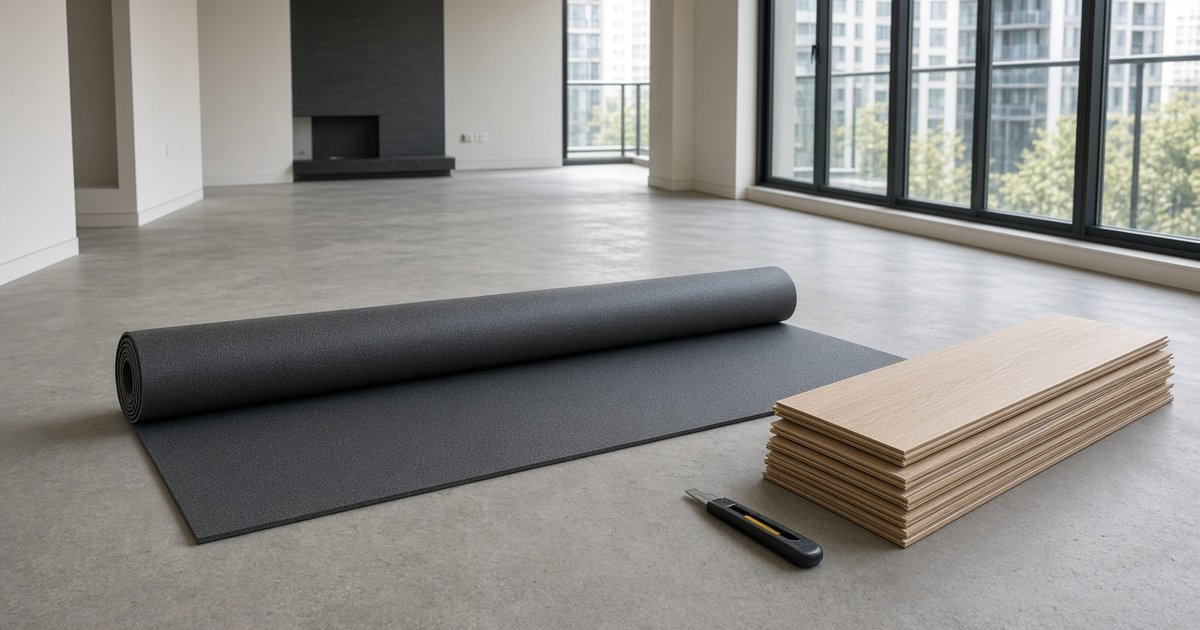
You can hear every step from upstairs. Or you're putting a new floor in your condo, and you don't want the neighbours below to hear you. Can the floor itself be quieter?
Yes. A good place to start is a layer you never see: the underlay. Here is how to pick one for your type of floor, and how to read the sound numbers on the product page.
Short answer: To make a floor quieter, put an acoustic underlay under it, one made for your type of floor. Floating laminate and engineered wood, floating vinyl, glued-down tile and carpet each use a different kind. On the product page, compare the IIC number for footsteps and the STC number for voices. A higher number is better, but only compare numbers tested the same way. In a condo, ask your building which rating it needs before you buy.
| Your floor | Kind of acoustic underlay | Example on FloorBox, and what its page says |
|---|---|---|
| Floating laminate or engineered wood | Thin roll that goes under the planks | QuietMAXX: 70 IIC, 71 STC, 2.2 mm |
| Floating click vinyl | Thin roll made for vinyl | AcoustiTECH LV: 2.1 mm, never glued |
| Tile, stone or other glued-down floors | Rubber mat glued under the floor | GenieMat RST: IIC 50-58, under directly glued floors |
| Wall-to-wall carpet | Acoustic carpet cushion | Duracushion: 6 mm rubber, IIC 84 in its test |
Acoustic underlays can list two sound ratings. For both, a higher number means better sound control.
If someone lives below your floor, look at IIC first. Our post Do I Need Underlay Under Laminate or Vinyl Plank? covers the basics of underlay for those two floors.
Because the number depends on the whole floor it was tested on, not only on the underlay. The product pages say so:
So a number tested on thick concrete with a ceiling below can't be compared with a number tested on a wood floor with no ceiling. Compare numbers only when the test setup is the same. If the page doesn't say, check the technical data sheet attached to it.
Floating laminate and engineered wood sit on a thin underlay roll. FloorBox has them in Laminate & Hardwood Underlayments. Three examples:
Planks with a pad already attached? Check the plank page before you add a second layer.
Use one that is made for vinyl. AcoustiTECH LV is a 2.1 mm acoustic underlay for floating click vinyl planks. Its page sets three rules:
See all of them in Vinyl Underlayment.
Yes, with a rubber mat that goes under the tile. GenieMat RST is made for floors that are glued down, like tile, stone, wood and vinyl. Its page says:
More options are in Membranes & Underlayments.
Wall-to-wall carpet sits on a cushion, and some cushions are made for sound. Duracushion is a 6 mm recycled rubber cushion. Its page names condos and stair runners, and gives IIC 84 on its test floor. See Carpet Underlayment.
Before you buy anything, ask your condo board or building manager:
Then pick an underlay for your floor type that meets that rule, with the test details on its data sheet. Not sure which one fits? Contact us.
Does underlay really reduce noise?
An acoustic underlay does. Many acoustic underlays list an IIC number, and some an STC number, on their FloorBox page. A higher number means better sound control.
What is the best acoustic underlay for a condo?
The one made for your floor type that meets your building's rule. Ask your condo for its minimum rating first, then compare data sheets tested the same way.
Is a thicker underlay always quieter?
Thickness alone doesn't tell you. Compare the IIC and STC numbers and how they were tested, not only the thickness.
Can I put two underlays on top of each other?
Follow the plank maker's guide. For example, AcoustiTECH LV allows an attached pad of 1.5 mm or less on the vinyl planks, and no more.
Will an acoustic underlay stop noise from a basement?
It helps most with footsteps going down to the room below. If the noise you hear comes from upstairs, the underlay goes under the floor upstairs, not under the basement floor.