
Click vinyl planks lock to each other at the edges, so the floor holds together without glue or nails. The floor then rests on the subfloor. This is called a floating floor. In a basement, that changes three things. The concrete has to be flat and dry enough. The floor needs a small gap at the walls. And the pad is often already attached under the plank. FloorBox click planks are in Vinyl Planks. Below, each line on a click plank page is explained in plain words, with five planks as examples.
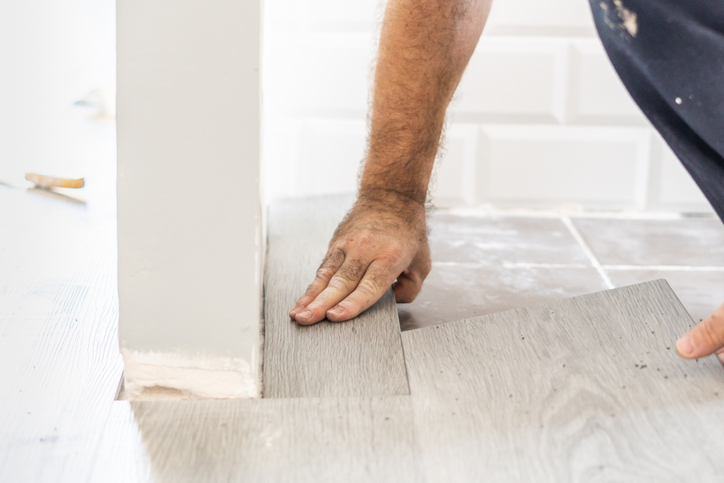
Open the product page and read Installation Method in the specifications. The Planchers 1867 Vinyl Planks Evolution Magma Pro Fog Click Lock 5-7/8" x 48", the MSI Surfaces Vinyl Planks Cyrus Wolfeboro Click Lock 7" x 48", the Torlys Smart Floors Vinyl Planks RigidWood Firm Vista Mooring Click Lock 6" x 47-3/4", the Fuzion Flooring Vinyl Planks Dynamix Endure Hopewell Click Lock 7" x 48" and the Next Floor Vinyl Planks StoneCast Incredible Toasted Barnboard Click Lock 7" x 48" all list Click Lock. A plank that lists Glue Down is held to the floor with adhesive instead. The next line, Installation Method Precision, names the kind of lock.
Not sure which kind of vinyl you are looking at? Our guide What Are the Types of Vinyl Flooring, and Which One Fits a Basement? explains the differences in plain words.
Each plank has a tongue on one edge and a groove on the other. The Torlys installation guide calls it a tongue-and-groove system that locks the planks together. Planks close in one of two common ways.
RigidWood Firm uses the Torlys Uniclic joint. Its guide says to angle the plank in, or tap it in with a tapping block using several small taps. Never knock a joint in with one hit, and never hit the plank directly with the hammer.
There is no glue between the planks. The joints hold the floor together, and the floor floats on the subfloor. The Torlys guide says floating is the main way to install RigidWood Firm, and says not to glue the planks together. The Hopewell page also says the planks can be floated. All five planks have a pad already attached underneath (Underpad Attached: Yes). It is EVA foam on Magma Pro, 1 mm IXPE foam on Cyrus, FoamPlus Blue on RigidWood Firm, a 1 mm acoustic pad on Hopewell, and an attached cushion on StoneCast. The Cyrus page says its attached backing is for comfort underfoot. Torlys says FoamPlus Blue cuts sound and absorbs shock. Because that pad is built in, the Torlys guide says no extra underlayment is needed.
Look for Grade Level on the page. Below grade means below ground level, where most basement floors are. RigidWood Firm lists On, Above and Below. Hopewell lists on, above or below grade. The Cyrus page says above, on or below grade, names the basement, and says indoor, temperature-controlled spaces only. The technical data sheet on the StoneCast page says click floating floor, on, above or below grade.
Water is the next question. The Magma Pro, Cyrus and StoneCast pages say 100% waterproof, and the Hopewell page calls the floor waterproof. RigidWood Firm lists Water Resistant: Yes, and says its joint keeps water on the surface of the floor.
The slab still has to be ready, even under a waterproof plank. The Torlys guide asks for a subfloor that is clean, firm, smooth, dry and flat within 3/16 in. over 10 ft (4.8 mm over 3 m). It asks for a moisture test on concrete: 80% relative humidity or less, read with a probe in the slab. Torlys says an uneven subfloor can damage the floor early and make it feel unstable. In plain words: fix dips and bumps, and test the concrete before the planks go down. The same guide says to leave the closed boxes in the middle of the room for 24 hours at 16 to 21 °C first.
Heated floor in the basement? Magma Pro and RigidWood Firm list electric and hydronic (hot-water) radiant heat. Hopewell lists hydronic only.
The wear layer is the clear top layer that takes scratches and scuffs. The FloorBox Vinyl page says this layer resists scratches and stains, and that its thickness matters most for how long the floor lasts. It recommends at least 0.3 mm. All five planks list 12 mil, which their pages also show as 0.3 mm. A mil is a thousandth of an inch.
Total thickness is 4.5 mm on Magma Pro, RigidWood Firm and Hopewell, and 5 mm on Cyrus and StoneCast. The same Vinyl page says a thinner floor does not always mean a shorter life; the wear layer counts more.
Core Type Detail tells you what the plank is built on. Magma Pro, RigidWood Firm, Hopewell and StoneCast list SPC, which the Vinyl page describes as stone and PVC. Cyrus lists Rigid Core / Solid Vinyl, with SPC as its material. Rigid means the plank itself is stiff. Torlys says RigidWood Firm resists dents better than traditional LVT.
A floating floor needs room to expand and contract. The Torlys guide asks for at least 1/8 in. (3.2 mm) at every wall, and around pipes and thresholds. The gap is hidden by a baseboard or a moulding fixed to the wall, not to the floor. FloorBox carries Vinyl Floor Moldings. For a big open basement, Torlys says RigidWood Firm can go in spaces up to 70 ft x 70 ft with no transition strip.
Measure the length and the width in feet and multiply them, as in How to Calculate Square Footage for Flooring. Then read Coverage (sqft), the area one box covers: 23.63 for Magma Pro, 23.77 for Cyrus, 23.47 for RigidWood Firm, 26 for Hopewell and 28.4 for StoneCast. The Torlys guide says to add 5% for cutting. Divide the total by the box coverage and round up to a full box.