
Where two floors meet, you need a strip to cover the joint. It hides the gap, protects the edges and makes a safe step from one floor to the next. The right strip depends on one question: are the two floors the same height or not? This guide explains the main types and when to use each one.
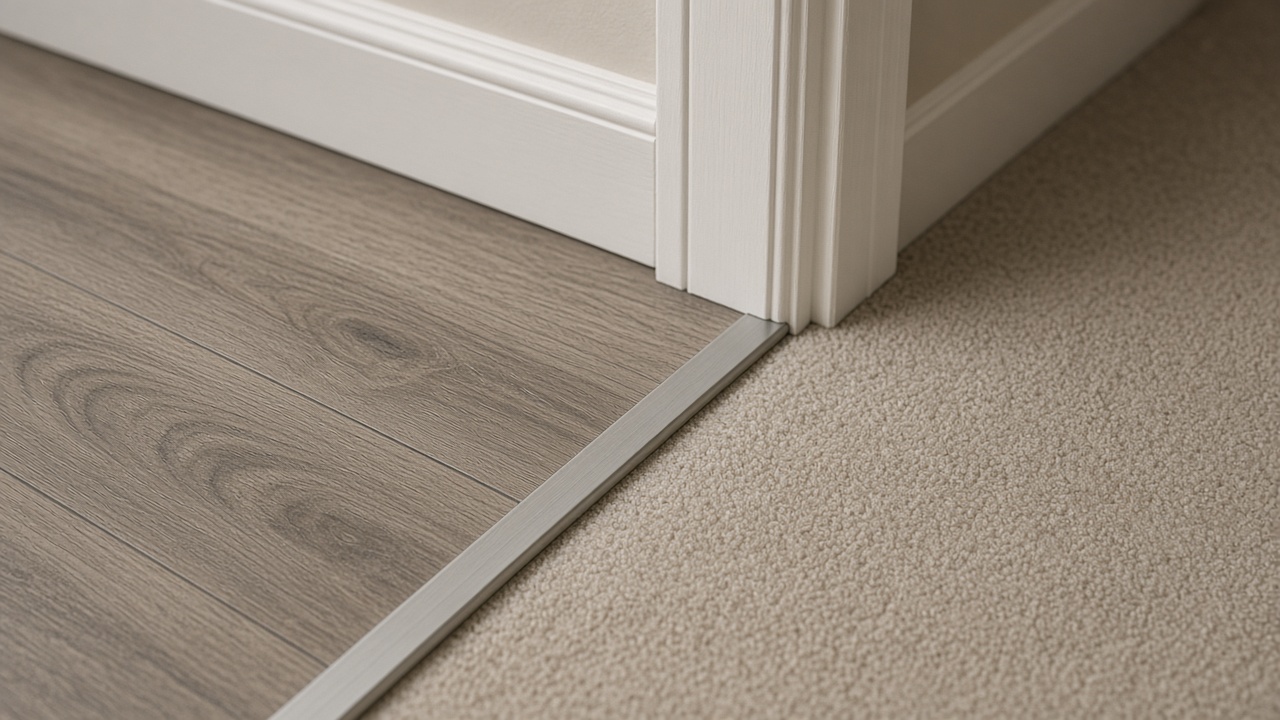
The FloorBox Vinyl T-Molding page says these strips connect floors between rooms and finish doorways and expansion gaps. An expansion gap is the small space left at the edge of a click floor. The strip covers that space and the cut edge where your floor meets another one.
Use a T-moulding. It is shaped like a T: the leg sits in the gap and the top covers both edges. The M-D PRO Cinch T-Molding with Snaptrack, Satin Silver 1 1/2" x 3' is one example. Its page says it bridges the gap between floors of similar height. It is aluminum and 3 ft long.
If you want a strip in the same colour as your floor, look at Vinyl T-Molding (above) or Laminate T-Molding.
Use a reducer. It slopes down from the higher floor to the lower one, so no one trips on the edge.
Reducers that match your floor are in Vinyl Reducer and Laminate Reducer.
Use a strip made for that joint. The M-D PRO Aluminum LVT to Carpet Transition, Satin Titanium 9/32" x 12' is for the line where vinyl tile or plank meets low-pile carpet. It is 12 ft long, so you can cut it for several doorways.
At the edge of tile, you can use the Schluter RENO-VB Transition Profile Anodized Aluminum Satin 3/4" x 8' 2 1/2". It is an anodized aluminum transition piece that works together with the Schluter RENO-VT carrier profile, so you can adjust it to the height you need. More profiles are in Tile Transitions.
Measure two things before you buy. First, the thickness of each floor, because many strips are made for one floor thickness. Second, the width of the doorway, so you know how many pieces to buy. Our guide How to Calculate Square Footage for Flooring also helps you measure the room.