
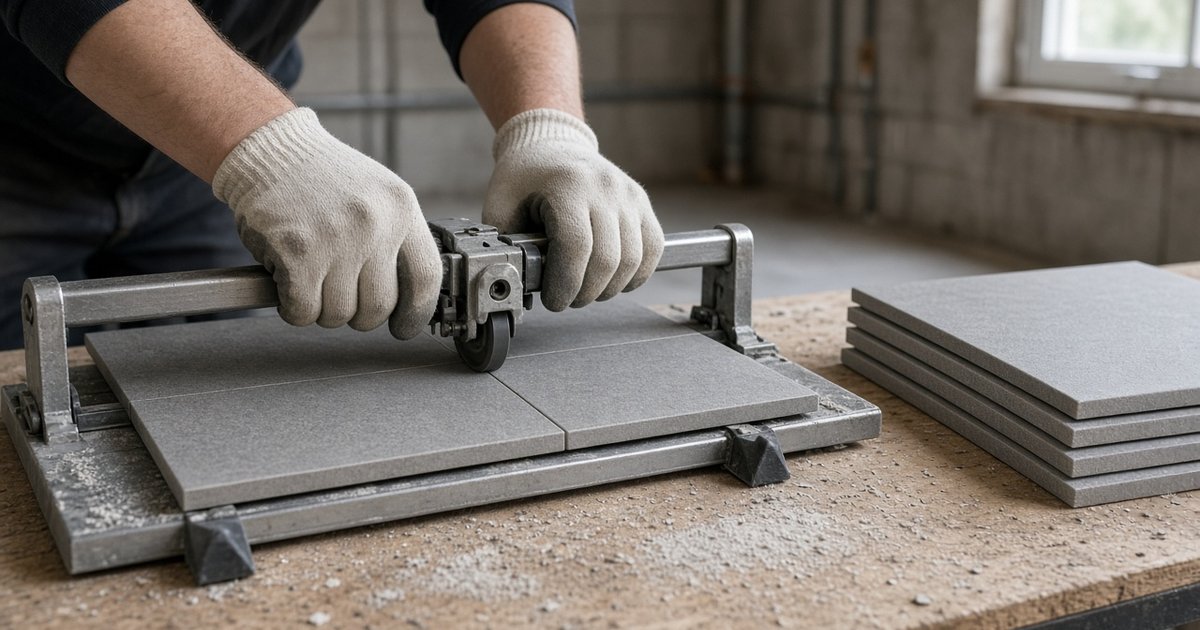
You have your tile and your thinset. Now you need to cut tile to fit along the walls, around a door frame and around pipes. There are two main tools for this: a manual tile cutter and a wet saw. Here is what each one does, so you know which one your project needs.
Short answer: For straight cuts in ceramic or standard porcelain tile, a manual tile cutter is usually enough. It is quiet, needs no power and makes no dust. You need a wet saw for L-shaped and U-shaped cuts (notches), 45-degree edges, natural stone and very thick tile. Many people use both: the cutter for most straight cuts, the saw for the few hard cuts.
| Manual tile cutter | Wet saw | |
|---|---|---|
| How it cuts | Scores the tile with a wheel, then snaps it | A spinning diamond blade cooled by water |
| Best for | Straight cuts and diagonals in ceramic and standard porcelain | Notches (L and U cuts), 45° edges, natural stone, thick tile |
| Dust and noise | No dust, no motor | Water keeps the blade cool and cuts down dust; it has a motor |
| Power | None | Needs power and water |
| On FloorBox | Tile Cutters | Tile Saws |
A manual tile cutter has a rail and a small hard wheel. You push the wheel across the tile to score a line. Then you press down on the breaking feet, and the tile snaps along the line.
The FloorBox page for the Sigma Serie 3 Max manual tile cutter says it plainly: the tile is "scored with a tungsten carbide wheel" and "then snapped by pressing with the breaking feet." Its guide also turns to 45 degrees, so you can cut tile on a diagonal.
Rubi, a tile tool maker sold on FloorBox, lists the main reasons people like a manual cutter:
Rubi says a manual cutter is the right tool for straight cuts in ceramic and standard porcelain tile. That covers the straight cuts along the walls. Rubi notes that on most floors, those cut edges end up hidden under a baseboard or a transition strip.
For big or thick porcelain tile, pick a cutter made for it. The Sigma Serie 4 Nex manual tile cutter cuts tile up to 3/4 in. (19 mm) thick and up to 29.9 in. long, and its page says it is made for rough, thick and large tiles. Before you buy any cutter, check two numbers on its page: the longest cut and the thickest tile it can handle.
Rubi lists the jobs a manual cutter cannot do. You need a wet saw for:
A wet saw uses a diamond blade. Water runs over the blade while it spins. Rubi explains that the water cools the blade and cuts down the dust.
The DeWalt 10 in. wet tile saw with stand is one example on FloorBox. Its page lists rip cuts up to 25 in., a diagonal cut on 18 in. x 18 in. tile, and water nozzles you can adjust to limit spray. Replacement blades are in Saw Blades.
For curves, such as around a pipe, our guide on how to install floor tiles uses tile nippers: mark the line, then take off small bits of tile along it. You can find them in Tile Nippers and Rub Bricks.
Next step: our guide on how to install floor tiles walks through the whole floor. Not sure which tool fits your tile? Contact us and tell us the tile size and thickness.
Can a manual tile cutter cut porcelain tile?
Yes, for straight cuts in standard porcelain. For large or very thick porcelain, choose a cutter made for it and check its maximum thickness on the product page.
Can a manual tile cutter cut natural stone?
Generally, no. Rubi recommends a wet saw (an electric cutter with water) for natural stone.
Does a manual tile cutter make dust?
No. It scores and snaps the tile, so nothing is ground into dust.
Can I cut a notch with a manual tile cutter?
No. L-shaped and U-shaped cuts need a wet saw. Small curves can be nibbled with tile nippers.