
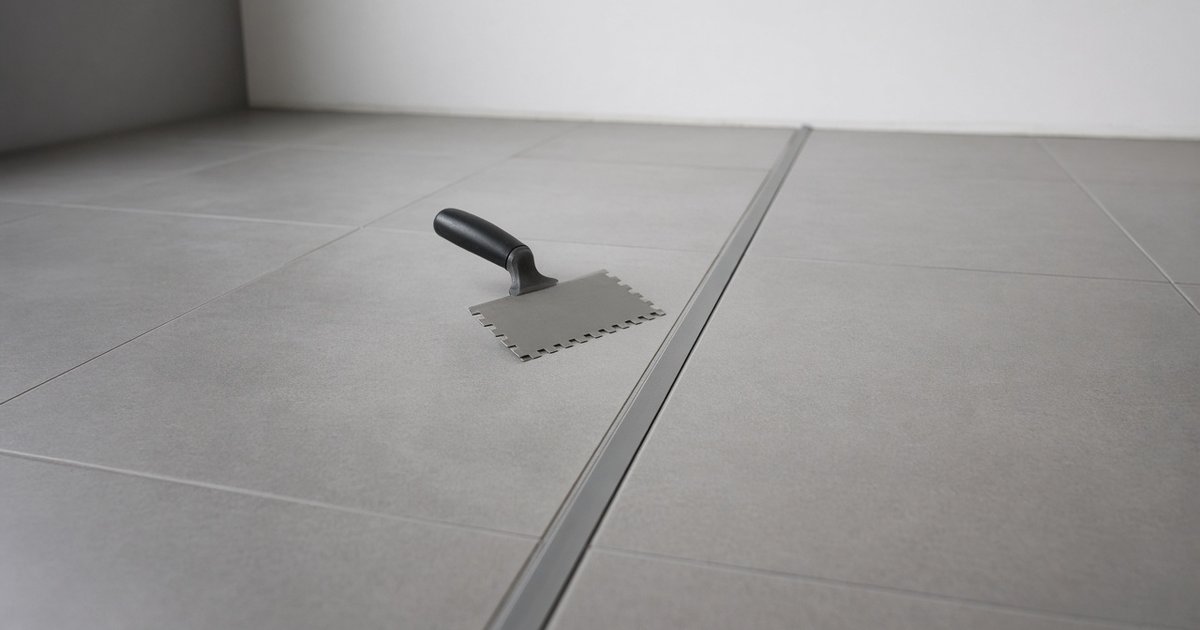
A tile floor looks solid, but everything under and around it moves a little. A movement joint gives that movement somewhere to go, so your tile and grout do not crack. Here is what a movement joint is, where it goes, and how to pick one.
Short answer: A movement joint is a soft, flexible line in a tile floor or wall. Schluter, a tile systems maker sold on FloorBox, says movement joints must be built into large tiled areas, at doorways, and where tile meets walls and other fixed parts of the house. Without them, the stress can crack the grout and tile and loosen the tile from the floor. Schluter's DILEX profiles are ready-made movement joints that you set in the thinset as you tile.
Schluter compares an installed tile floor to a large sheet of glass: it is rigid. Each layer (the tile, the thinset, the subfloor) grows and shrinks a little with changes in moisture, temperature and weight. Walls and columns keep the tiled area from moving as a whole. Schluter says that if this movement has nowhere to go, the stress can crack the grout and tile and make the tile come loose.
Schluter names three main places:
One more rule from Schluter's install steps: if the floor under the tile has a movement joint (for example a joint in a concrete slab), the profile must line up directly over it.
How far apart surface joints go depends on your project. Follow your tile and setting material installation guides, or contact us with your room size and tile.
A DILEX profile is a ready-made movement joint. It has perforated legs that go into the thinset under the tile edge, and a soft strip on top that you see between the tiles. Schluter says these profiles replace caulking, protect the tile edges, and stop sound and surface water from passing through the joint.
| Where | Profile | What the FloorBox page says |
|---|---|---|
| Inside the tiled floor, homes | DILEX-BWS | Soft strip 3/16 in. wide, matching common grout joints. Homes and medium-duty commercial spaces with light loads (offices, stores). Takes limited movement |
| Inside the floor, more movement | DILEX-BWB | Schluter says to use BWB (3/8 in. strip) when larger movement is expected, or to add more BWS joints to make smaller sections |
| Against a tub, shower base or door frame | DILEX-BWA | A perimeter joint that bonds to fixed parts such as door and window frames, bathtubs and shower bases. Also helps block sound |
| Inside corners and where the floor meets the wall, showers | DILEX-EKE | A corner movement joint for floor-to-wall transitions and inside wall corners. Its page calls it an ideal profile for showers |
| Heavy commercial traffic | DILEX-KSN | Schluter says KSN, with stainless steel legs, is made for heavy commercial traffic such as warehouses and shopping malls |
All of these are in Movement Joints. Each product page shows the length (many DILEX profiles are 8 ft 2-1/2 in., or 2.5 m), the colour and the height.
Have these four things ready:
Schluter's steps for surface profiles like DILEX-BWS:
For the rest of the tile job, see how to install floor tiles, modified or unmodified thinset and how to finish tile edges.
Is a movement joint the same as an expansion joint?
The two are close. Schluter sorts its DILEX family this way: surface joints inside the tile, perimeter joints at walls and fixed parts, and expansion joint profiles with wider movement zones (3/4 in. or 1-3/16 in. on DILEX-KSBT).
Can I just use caulking instead?
Schluter's DILEX profiles are made so you do not need caulking. They also protect the tile edges.
Which movement joint goes in a shower corner?
DILEX-EKE is made for inside corners and floor-to-wall transitions, and its FloorBox page calls it an ideal profile for showers.
Do I need a movement joint in a small room?
Schluter says perimeter joints go where tile meets walls and fixed parts. Surface joints inside the floor are for large areas. If you are not sure, contact us.