
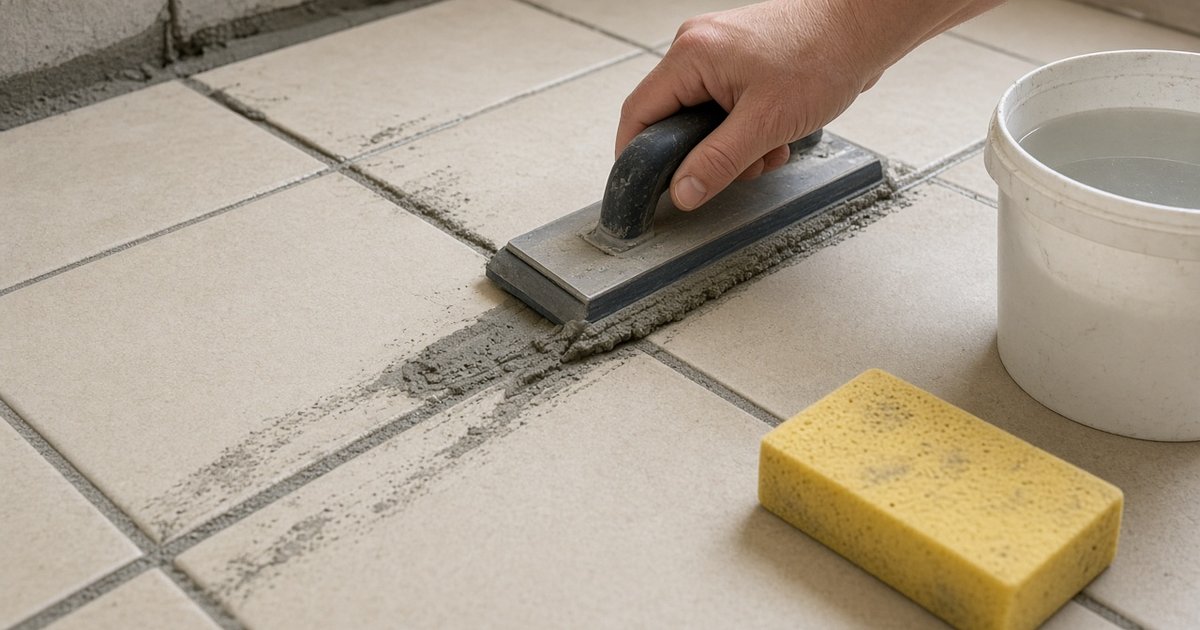
Grout fills the lines between your tiles. This guide compares two kinds: cement grout, which you mix with water, and epoxy grout, a resin you mix with a hardener. They are very different to work with.
Short answer: Cement grout mixes with water and works on regular tile floors and walls. Epoxy grout needs no sealer and is made to resist stains, which is why it is chosen for countertops and high-traffic areas. The trade-off: epoxy must be washed off the tile within minutes and is very hard to remove once it cures, so you work in small areas and clean as you go.
| Cement grout | Epoxy grout | |
|---|---|---|
| Made of | Cement with polymers, mixed with water | Two or three parts mixed together (Kerapoxy CQ: resin and hardener) |
| Example on FloorBox | MAPEI Ultracolor Plus FA, LATICRETE PermaColor | MAPEI Kerapoxy CQ, LATICRETE SpectraLock Pro Premium |
| Sealer | Depends on the product: Ultracolor Plus FA needs none; for PermaColor sealing is optional | Not needed |
| Stains | Some are stain-resistant: check each product page | Made to resist stains |
| Time in the pail | Ultracolor Plus FA: 30 minutes to 1 hour | Kerapoxy CQ: 45 to 60 minutes |
| Cleanup | Follow the product page | Final wash within 15 to 20 minutes; very hard to remove once cured |
Cement grout is a powder you mix with water. The two examples on FloorBox are both improved with polymers:
Epoxy grout comes in two or three parts that you mix together just before you use it. It hardens by a chemical reaction, not by drying.
It asks for more care, even though the Kerapoxy CQ page calls it easy to apply. The data sheet on its FloorBox page lists the main points:
If you choose epoxy, read the data sheet before you start and have your sponges and clean water ready.
Always check the joint width on the product page: each grout is made for a range of joint sizes.
For both types: a grout float to push grout into the joints and grout sponges to clean the tile. All grouts on FloorBox are in Grout. For the step-by-step, see our guide on how to grout tile.
Not sure which grout fits your tile and joints? Contact us with your tile type and joint width.
Does epoxy grout need to be sealed?
No. Kerapoxy CQ and SpectraLock Pro Premium both say no sealer is needed.
Is epoxy grout waterproof?
The product pages do not use the word waterproof for grout. SpectraLock Pro Premium's page lists swimming pools, fountains and other wet areas among its uses. Waterproofing a shower is the job of the membrane behind the tile, not the grout. See is cement board waterproof.
How long before I can walk on new grout?
It depends on the product. Ultracolor Plus FA: 3 to 4 hours. PermaColor: heavy foot traffic in 6 hours. SpectraLock Pro Premium: light traffic in 12 hours and heavy traffic in 24 hours at 70°F. Kerapoxy CQ: no walking for at least 24 hours and no heavy traffic for 48 hours; full cure takes 14 days.
Can a beginner use epoxy grout?
If you try it, follow the Kerapoxy CQ data sheet: mix full units, grout and clean small areas, and do the final wash within 15 to 20 minutes. For large projects, it suggests working in teams of 2 to 3 people.