
You're building a shower in your basement bathroom. The walls are framed, and you need something behind the tile. Many people think cement board keeps the water out on its own. That's not quite how it works.
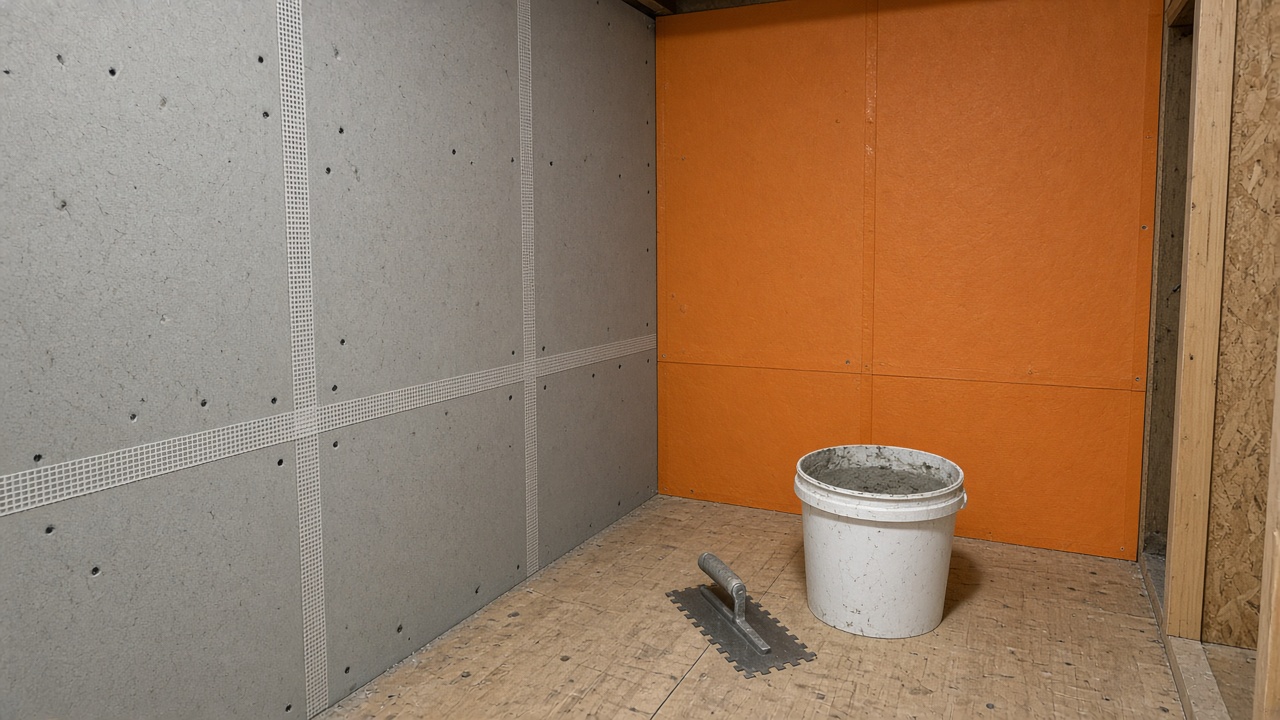
Cement board is the solid backing that the tile sticks to. Keeping water out of your wall is a different job. That job belongs to a waterproofing membrane, or to a board that is made to be waterproof. This guide explains the difference in plain words. That way, you buy the right layers the first time.
Tile backer board is a flat, solid panel. You screw it to the wall studs. It gives the tile a strong, stable surface to stick to. FloorBox carries two main families:
You can see the cement boards in Plywood and Cement Boards.
Cement board is made to handle moisture. The PermaBase page says it is "highly moisture resistant, and will not rot, disintegrate or swell when exposed to water." So water won't ruin the board itself.
But moisture resistant is not the same as waterproof. The board is not the layer that stops water from getting into your wall. You can download the Durock cement board installation guide from its FloorBox page. It says that for a waterproof wall, you should add a waterproofing membrane. In other words, the board's own maker treats waterproofing as a separate layer.
Not sure what the two words mean? Waterproof or Water-Resistant Flooring explains the difference.
If your shower walls are cement board, plan for a waterproofing membrane over it. There are two kinds.
Sheet membrane. Schluter KERDI is a thin sheet that bends easily. Its page calls it a "bonded waterproof membrane and vapor retarder." In plain words:
Liquid membrane. Mapei Mapelastic AquaDefense goes on with a roller or a brush. Its page says it goes on easily over flat, curved or uneven surfaces. It forms a thin barrier with no gaps. Before you tile, follow the drying and flood-test steps on its technical sheet.
You can compare options in Shower Waterproofing Membranes.
Yes. Some foam boards are built to be waterproof. The Prova Board-Plus page says:
What that means for you: the board itself is waterproof. But the seams and screw holes still need the maker's fasteners and sealant. The board alone does not do the whole job.
| Cement board (PermaBase) | Foam board (Prova Board-Plus) | |
|---|---|---|
| What the page says about water | Moisture resistant | 100% waterproof core |
| In a shower | Add a waterproofing membrane | Seal seams and screws with the maker's products |
| Size and weight on the page | 3 ft x 5 ft, about 43 lb | 4 ft x 8 ft, 54 lb |
The PermaBase page says you can cut it with a standard utility knife.
The foam board sheet is more than twice the size of the cement board sheet. Yet it weighs only a little more. So for its size, the foam board is much lighter.
Whichever board you pick, follow one maker's instructions from start to finish. For example, the KERDI page points to Schluter's shower installation handbook. It has the full steps and the warranty conditions.
The floor of the shower is a different job. Shower Base or Shower Pan explains your choices. Are you tiling the bathroom floor too? What Is an Uncoupling Membrane? explains what goes under floor tile.
To put the cement board up, see How to Install Cement Board.
Can I tile directly on cement board in a shower without a membrane?
The Durock installation guide says to add a waterproofing membrane when you want a waterproof wall. In a shower, plan for one.
Is a sheet membrane or a liquid membrane better for a shower?
Both do the same job. A sheet like KERDI is pressed into thin-set, and the tile goes right on it. A liquid like AquaDefense is rolled or brushed on. That can be easier on curved or uneven spots. Pick the one that suits your walls, then follow its instructions.
Do I still need a membrane with a waterproof foam backer board?
The Prova Board-Plus core is waterproof. To make the whole wall watertight, the page says to install it with PROVA fasteners and PROVA-SEAL.
What mortar do I use with a KERDI membrane?
The KERDI page lists Schluter-SET, Schluter-ALL-SET, Schluter-FAST-SET or unmodified thin-set mortar.