
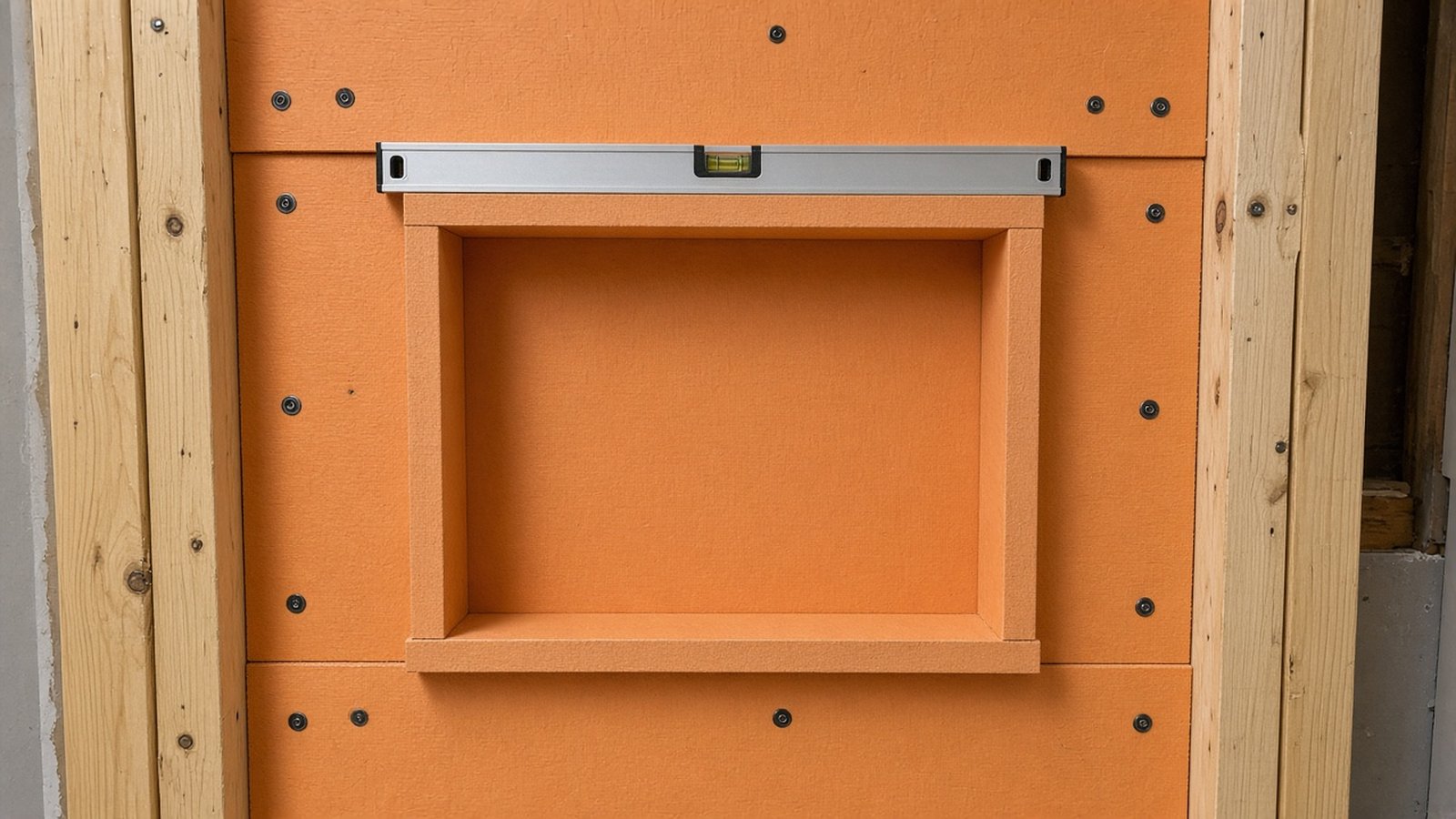
A shower niche is a recessed box in the shower wall for bottles and soap. Instead of building and waterproofing one from scratch, you can use a prefab niche: a ready-made box that goes between two wall studs and gets tied into the shower's waterproofing. Here is how to pick the size, where to put it and how it goes in.
Short answer: Pick a prefab niche that fits between your studs and lines up with your tile. Cut the wall opening the maker asks for, fasten the niche to the studs, and seal its edges to the wall's waterproofing with the band or membrane that comes with it. Then tile. Each system has its own steps, so always follow the instructions on the product page.
| Schluter KERDI-BOARD-SN | Wedi shower niche | Laticrete Hydro Ban preformed niche | Schluter DESIGN-NICHE | |
|---|---|---|---|---|
| Made of | Extruded polystyrene foam board | See the product page | High-density EPS foam | Powder-coated aluminium |
| Waterproofing | Waterproof board with sealed inside corners; KERDI-BAND frame ties it to the wall | Follow Wedi's instructions | Factory waterproofing that meets ANSI A118.10 | Comes with KERDI-BAND and KERDI-FIX |
| Inside finish | You tile it | You tile it | Ready to tile | Finished: no tile inside |
| Example on FloorBox | KERDI-BOARD-SN 12 x 20 | Wedi 16 x 22 x 4 | Hydro Ban Mega | DESIGN-NICHE 12 x 24 |
See them all in shower niches.
Start with your wall, not the niche. A prefab niche is made to sit between two studs, so measure your stud spacing first. Then check three numbers on the product page:
Think about what goes in it. A tall niche (20 or 28 in.) fits tall bottles; a short one (6 or 12 in.) suits soap and a razor.
Here are Schluter's steps for KERDI-BOARD-SN, the tile-ready niche. Other systems differ, so follow the instructions for the niche you buy.
The KERDI-BOARD-SN 12 x 20 comes with its KERDI-BAND frame and 8 screws and washers. Schluter says it is fully waterproof and vapour-tight, shower-approved, for indoor use, and covered by a 10-year limited warranty.
It needs to be sealed to the wall. Even when the niche itself is waterproof, like KERDI-BOARD-SN, the joint between the niche and the wall is not until you seal it. That is why KERDI-BOARD-SN comes with a KERDI-BAND frame and DESIGN-NICHE with KERDI-BAND and KERDI-FIX. Hydro Ban niches have factory waterproofing that meets ANSI A118.10. The rest of the wall still needs a membrane: see our guide is cement board waterproof? and our shower waterproofing tape and bands.
Next step: browse all shower niches. Building a curbless shower too? Read what is an Italian shower. Odd stud spacing? Contact us before you order.
How big a hole do I cut for a shower niche?
It depends on the niche, and the hole is bigger than the inside. For Schluter KERDI-BOARD-SN, you trace around the outside of the flange and cut along that line. Schluter's data sheet gives that outside size as 16 in. wide and 10, 16, 24 or 32 in. high, depending on the niche.
How deep is a shower niche?
It depends on the niche, so check the product page. Schluter KERDI-BOARD-SN is 3-1/2 in. (8.9 cm) deep, and the Wedi 16 x 22 niche is 4 in. deep.
Does a shower niche have to go between studs?
A prefab niche does. Schluter says to cut the opening so the niche is supported on both sides by studs, then fasten it to the studs.
Do I tile inside a shower niche?
For a tile-ready niche like KERDI-BOARD-SN or Wedi, yes. A finished niche like Schluter DESIGN-NICHE needs no tile inside.