
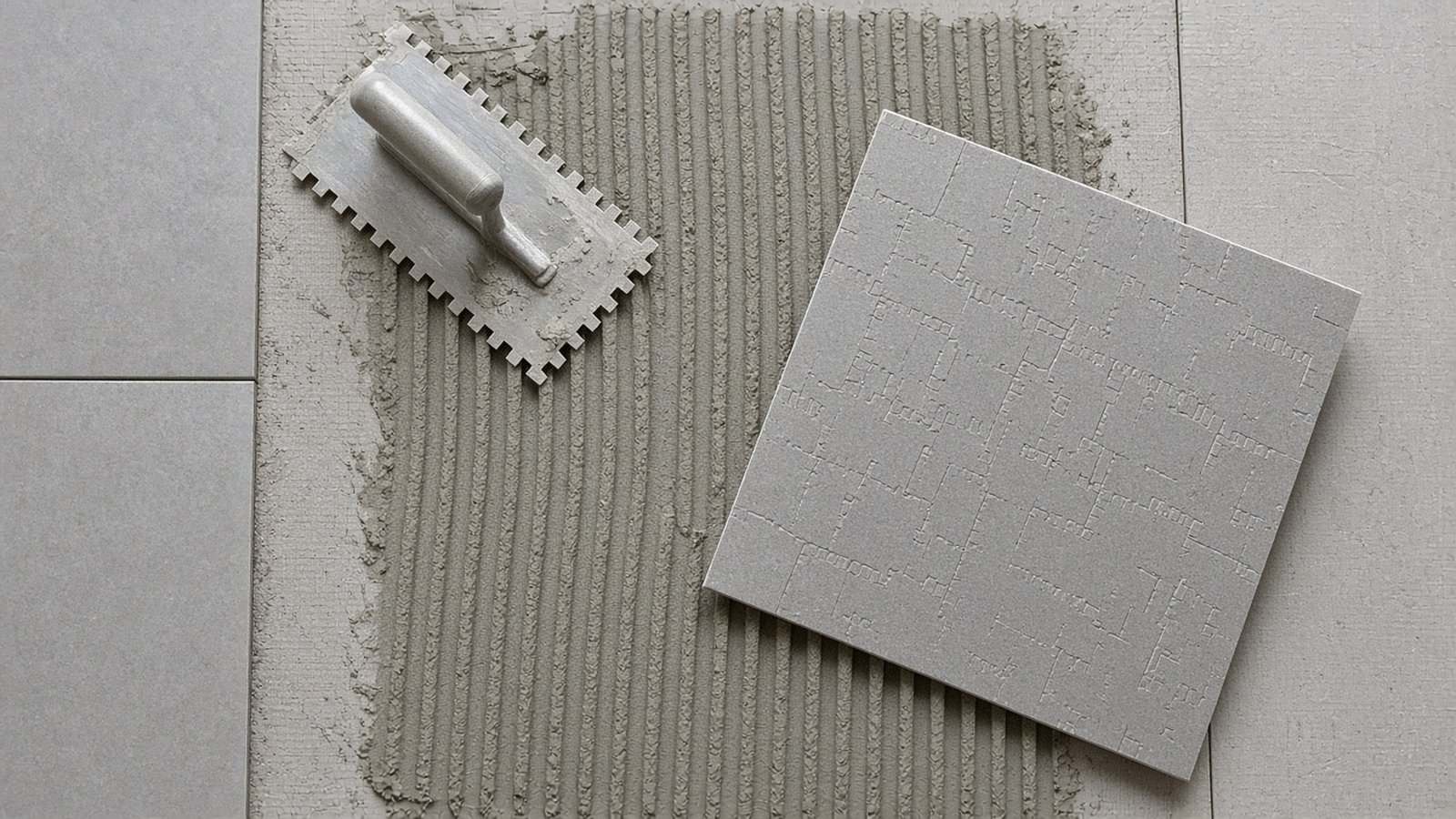
You have your tile and your thinset. Now you need a notched trowel, and there are several notch sizes. The notch decides how much mortar ends up under each tile, so the right one matters. Here is the simple rule mortar makers use, and how to check you got it right.
Short answer: Go by the longest side of your tile. The VersaBond data sheets from Custom Building Products give this guide: under 8 in., a 1/4 x 1/4 x 1/4 in. square notch; 8 to 15 in., a 1/4 x 3/8 x 1/4 in. square notch; over 15 in., a 1/2 x 1/2 x 1/2 in. square notch or a 3/4 x 9/16 x 3/8 in. U-notch with a large format tile mortar. Then lift a tile now and then to check the mortar covers its back.
| Longest side of the tile | Trowel (from the VersaBond / VersaBond-LFT data sheets) | Coverage per 50 lb bag | Example trowel on FloorBox |
|---|---|---|---|
| Less than 8 in. (mosaics, 4 x 4, 6 x 6) | 1/4 x 1/4 x 1/4 in. square notch | 85 to 95 sq ft (VersaBond) | Rubi 1/4 x 1/4 x 1/4 |
| 8 to 15 in. (12 x 12) | 1/4 x 3/8 x 1/4 in. square notch | 60 to 67 sq ft | Rubi 1/4 x 3/8 x 1/4 |
| More than 15 in. (12 x 24, 24 x 24) | 1/2 x 1/2 x 1/2 in. square notch | 42 to 47 sq ft (VersaBond-LFT) | See trowels |
| More than 15 in. | 3/4 x 9/16 x 3/8 in. U-notch | 34 to 38 sq ft (VersaBond-LFT) | See trowels |
A trowel size has three numbers: the width of each notch, its depth and the space between notches. Mapei's data sheet spells it out: width / depth / spacing. So a 1/4 x 3/8 x 1/4 in. trowel has notches 1/4 in. wide and 3/8 in. deep, 1/4 in. apart. Deeper notches leave taller ridges of mortar, which bigger tiles need.
"Square notch" and "U-notch" are the shape of the teeth. Follow your mortar's chart.
Its longest side is 24 in., so it is in the "more than 15 in." row: a 1/2 x 1/2 x 1/2 in. square notch or a 3/4 x 9/16 x 3/8 in. U-notch. Use a mortar made for large tile. VersaBond-LFT is a non-sag, medium-bed mortar made for most large format porcelain, ceramic and natural stone tile. Our guide modified or unmodified thinset helps you pick the mortar.
The VersaBond data sheet recommends at least 80% coverage in dry areas and 95% in wet areas and outdoors. Mapei's Ker 121 data sheet gives similar numbers: choose a trowel deep enough for more than 80% mortar contact indoors, and more than 95% for exterior, commercial floors and wet areas. Both say you may need to back-butter the tile (spread a thin coat on its back) to get there.
From the VersaBond data sheet:
That's a different job: follow the membrane maker's instructions. For example, Schluter asks for a 1/4 x 3/16 in. V-notch trowel or its KERDI-TROWEL to set KERDI-BAND in thinset. See our guide is cement board waterproof? for shower walls.
Next step: browse trowels and mortars, or read how to install floor tiles. Not sure about your tile? Contact us with its size.
What size trowel for 12 x 12 tile?
Its longest side is 12 in., so the VersaBond chart says a 1/4 x 3/8 x 1/4 in. square-notch trowel.
What size trowel for 12 x 24 tile?
Its longest side is 24 in., over 15 in. The VersaBond-LFT chart says a 1/2 x 1/2 x 1/2 in. square notch or a 3/4 x 9/16 x 3/8 in. U-notch.
How do I know if I used the right trowel?
Pull up a tile and look at the back. Mortar makers ask for at least 80% coverage in dry areas and 95% in wet areas like showers.
Do I need to back-butter my tile?
Sometimes. VersaBond and Mapei both say back-buttering may be needed to reach the coverage they ask for.