
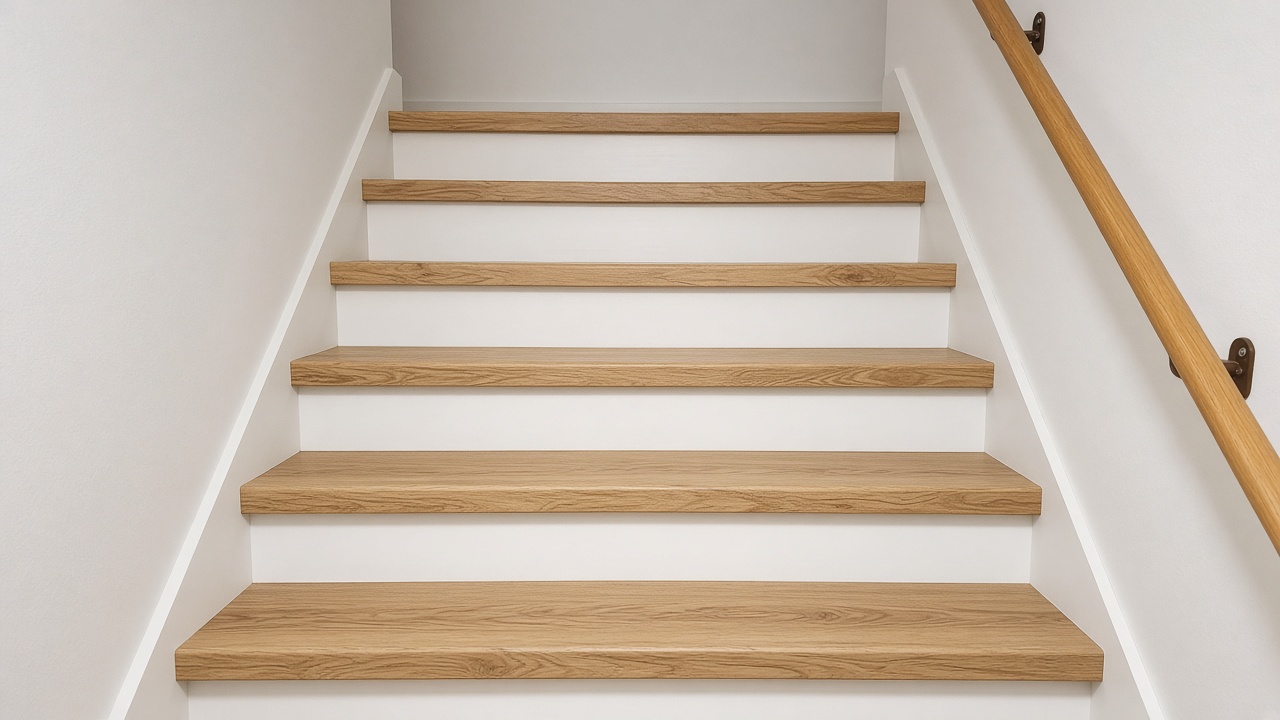
A new basement floor often means new stairs too. A plank alone does not finish the front edge of a step. For that, you need a stair nose: a long rounded piece that covers the edge and matches your floor. This guide explains what a stair nose does, which kind to pick, how laminate goes on stairs, and how everything is fixed in place.
Short answer: Yes, you can finish basement stairs with vinyl plank or with laminate. Each step gets a matching stair nose on its front edge. On stairs, the floor is not floated: TORLYS, a flooring maker sold on FloorBox, says laminate on stairs is glued down, with no underlay on the steps.
A stair nose is the trim on the front edge of each step. The FloorBox page for the Versatrim Stair Nose VersaEdge Standard PVC #3473 Boulder Oak 1" x 2" x 94" explains its job. The nose sticks out a little past the step, so your foot has more room. It makes the stairs safer and protects the step from wear.
A flush stair nose sits level with the planks on the step, so the top looks like one smooth surface. The FloorBox Vinyl Sierra Whistler Flush Stair Nose 94" is made to match the Sierra rigid-core (SPC) vinyl floor. It is 94 in. long, so one piece can cover a wide step.
An overlap stair nose sits over the edge of the step. The M-D PRO Vinyl Overlap Stair Nosing Flagstone #283 2 3/8" x 2 3/8" x 12' has large legs. Its page says this helps cover a damaged edge or a step with an unusually large drop.
Yes. Laminate (also called a floating floor) can go on stairs, but it is installed differently than on the floor. The TORLYS Smart Step installation guide, on the FloorBox page for the TORLYS SmartNosing Stowe Oak stair nosing, sets out the rules:
On a landing or in a hallway, where the floor still needs to float, TORLYS has a Floating Smart Step. It has a metal plate that is screwed to the subfloor, so the nose stays in place while the floor can still expand and contract.
The SmartNosing page says it is made from one piece of flooring with the same click joint as the floor, for an easy, seamless install. Laminate noses that match many floors are in Laminate Stair Nose.
Start from the floor you bought. Many floors have a nose made in the same colour:
More options for steps are in Stair Solutions.
Yes, for some laminate floors. The Toucan Laminate Flooring TF60 Series #6003 Stair Board Kit (Tread & Riser) comes with one finished tread (the part you step on) and one finished riser (the upright part). It matches the TF60 laminate in colour #6003. The tread is 47.3 in. wide and 11.8 in. deep, so check your steps before you order.
The nose is glued to the step. The Roberts Stair Nose Adhesive 8600 Nose Bond Acrylic 295 ml is made for wood, laminate and rigid PVC stair nosing. Here is what its page says, in plain words:
Always follow the installation guide of your floor and stair nose. If it names a different glue, use that one. For example, the TORLYS Smart Step guide asks for a modified polymer adhesive.
Yes. Carpet is soft and quiet on stairs. Our guide on what carpet is best for stairs helps you pick one, and how to install carpet shows the steps.
Not sure which nose matches your floor? Contact us with the name of your floor.
Do I need underlay under laminate on stairs?
No. TORLYS says never to add underlay on stair steps, because it would make the stairs unsafe.
Is laminate floated on stairs like on the floor?
No. TORLYS says laminate on stairs is glued down, as per building code.
Do I leave an expansion gap on each step?
TORLYS says there is no need for an expansion joint between treads and risers.
Can I use the same stair nose for vinyl plank and laminate?
Pick the nose made for your floor. Vinyl and laminate noses are in separate FloorBox categories, often in the same colour as the floor.