
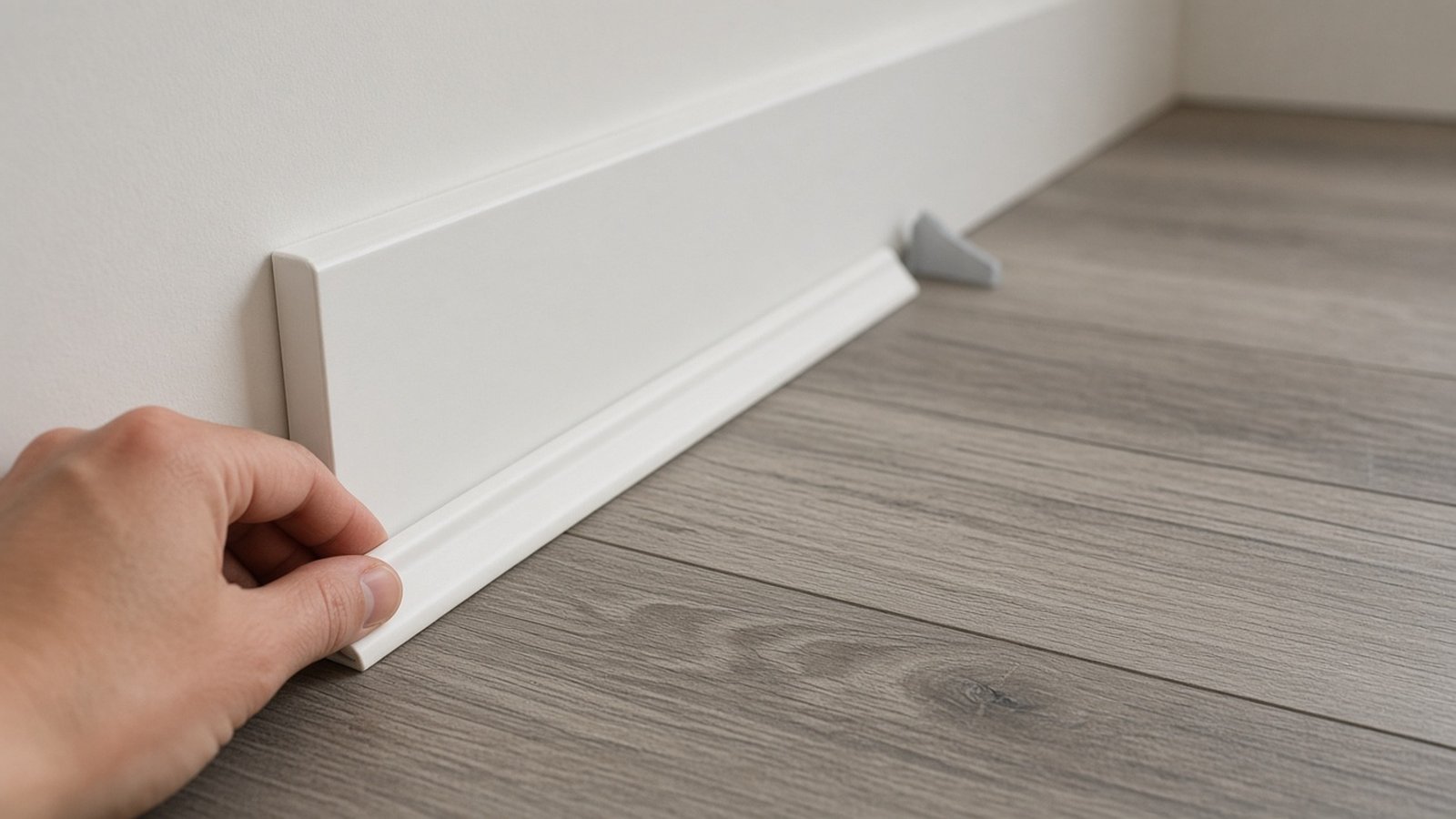
You finished your floating floor, pulled the spacers, and now there is a gap all around the room. That gap is supposed to be there. It just needs a moulding to cover it. Here is what each moulding does, so you can pick the right one.
Short answer: A floating floor needs an expansion space at every wall, and a moulding hides it. New baseboards installed after the floor can cover it on their own. If you keep your old baseboards, add quarter round or shoe moulding at the bottom. Nail the moulding to the wall or the baseboard, never to the floating floor.
| Baseboard | Quarter round | Shoe moulding (base shoe) | |
|---|---|---|---|
| What it is | The tall board along the bottom of the wall | A small moulding shaped like a quarter circle | A small moulding with a smaller profile than quarter round |
| When to use it | New baseboards installed after the floor | Old baseboards stay; or a matching finish for the floor | Old baseboards stay and you want a smaller profile |
| Example size on FloorBox | MDF baseboards in several heights | 11/16 x 11/16 in. primed pine | 7/16 x 11/16 in. primed pine |
| On FloorBox | Wall base & baseboards | Primed pine quarter round | Primed pine base shoe |
A floating floor isn't fastened to the subfloor. It needs room to move. The Toucan laminate installation guide, linked on Toucan laminate pages on FloorBox, asks for an expansion space equal to the thickness of the flooring along the walls and around posts and pipes. Its last step: once the floor is down, "install baseboard or quarter round to cover the expansion space."
So the gap is not a mistake. Leave it open and cover it with a moulding. Check your own floor's installation guide for the exact space it needs.
When you install new baseboards after the floor. The bottom edge of the baseboard covers the expansion space. See wall base and baseboards, including MDF baseboards you paint.
When the baseboards are already on the wall and you don't want to remove them. The quarter round goes at the bottom of the baseboard and covers the gap.
Toucan describes its concave quarter round simply: one side goes against the wall or baseboard, and the other side covers the space between the floor and the wall. Some floors have a quarter round that matches the plank colour, like this Toucan concave quarter round, made to match one Toucan laminate colour. Others come primed, ready to paint the same colour as your baseboard. Look for a matching one in laminate matching mouldings or vinyl matching mouldings.
Shoe moulding (also called base shoe) does the same job as quarter round, with a smaller profile. On FloorBox, the Moulure Alexandria primed pine base shoe is 7/16 x 11/16 in., while the matching quarter round is 11/16 x 11/16 in. Pick shoe moulding if you want a smaller trim. Flat shoe moulds in MDF, like the Grandeur 3/8 x 1-1/4 in. shoe mould, give a flatter look.
Never to the floating floor. The floor has to move under the moulding.
Next step: browse laminate matching mouldings. Still cutting the floor? Read how to cut laminate and vinyl plank. Can't find a match for your floor? Contact us.
Do I need quarter round with a floating floor?
You need something to cover the expansion space at the walls. New baseboards installed after the floor can do it alone. If you keep your old baseboards, add quarter round or shoe moulding.
What is the difference between quarter round and shoe moulding?
Both cover the gap at the bottom of the baseboard. Shoe moulding has a smaller profile: on FloorBox, the Alexandria base shoe is 7/16 x 11/16 in. and the quarter round 11/16 x 11/16 in.
Can I nail quarter round to a laminate floor?
No. A floating floor has to move. Nail quarter round to the wall or the baseboard with finishing nails.
How big is the gap I need to cover?
It depends on the floor. The Toucan laminate guide asks for an expansion space equal to the thickness of the flooring. Check your floor's installation guide.