
A basement floor sits on concrete, below ground level. That concrete can be cold, a little uneven and sometimes damp. Flooring a basement starts under the floor, not with the colour.
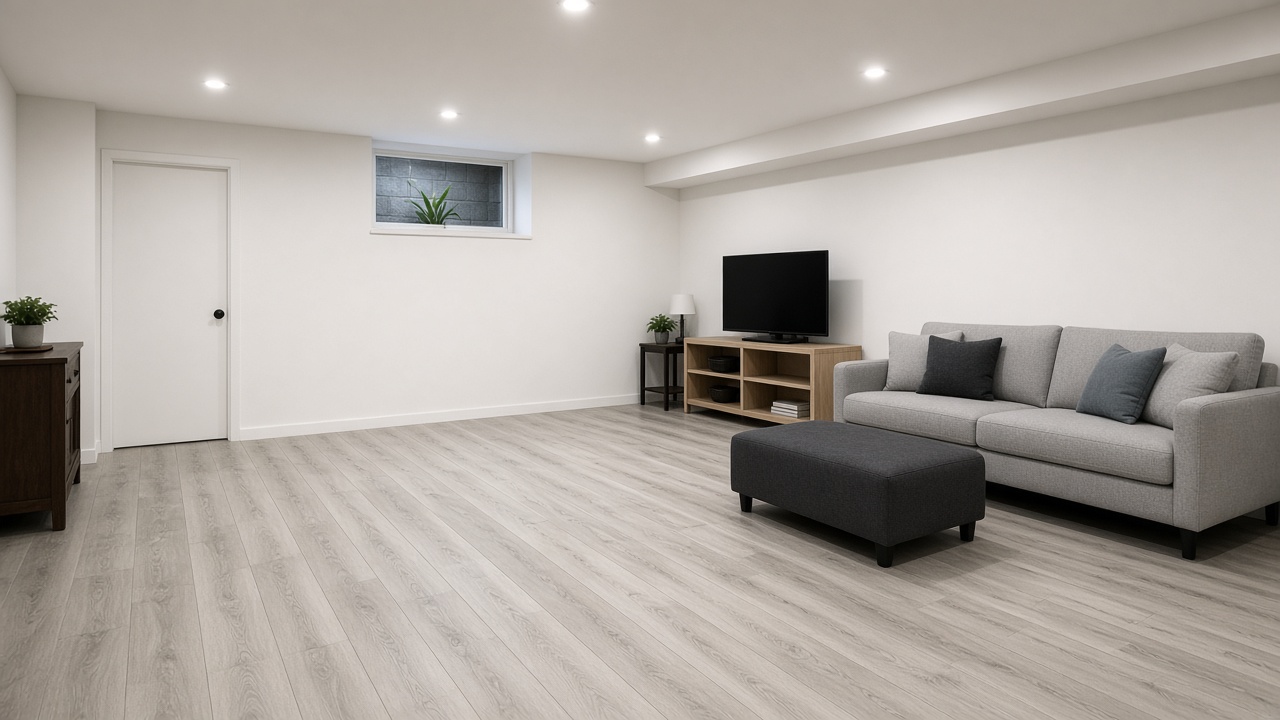
Short answer: for most Canadian basements, waterproof vinyl planks rated for below-grade use are the safest choice. They won't warp like laminate in a damp basement, and many have a pad attached. Carpet tiles suit a family room where you want something soft underfoot, and porcelain tile suits a basement bathroom or laundry room. Test the slab for moisture first, whatever floor you choose.
| Floor | Best for | Damp slab? | Underfoot | Shop on FloorBox |
|---|---|---|---|---|
| Waterproof vinyl planks | Most rooms | Pick one that lists below grade on its page | Firm; many have a pad attached | Vinyl Planks |
| Carpet tiles | Family room, playroom | Test first; a damaged tile can be replaced on its own | Soft | Carpet Tiles |
| Porcelain tile | Bathroom, laundry | Porcelain is denser and more waterproof than ceramic | Hard, cool | Tiles |
| Laminate | Dry basements only | Check the page: some list Water Resistant: No | Firm | Laminate |
| Linoleum (Marmoleum) | Natural-material floor | Glued down: test the slab and make it smooth | Firm, warm look | What Is Linoleum Flooring? |
This guide follows the order of the work: test the slab, prepare it, choose what goes under the floor, then pick the floor. Each step links to a FloorBox guide with more detail.
Start with moisture. Even a waterproof floor can have moisture build up under it if the slab is damp. Test first:
More tools are in Moisture Testing Tools. Each floor's install guide gives the result it needs before you install. Our guide Waterproof or Water-Resistant Flooring explains how to read the water lines on a product page.
Fix it before the new floor goes down. Fill cracks and small low spots with a patch. Products are in Floor Patch & Levelers & Primers. For a larger uneven area, our guide What Is Self-Levelling Underlayment? explains when you need it.
Between the concrete and your floor, you can add a subfloor panel or an underlayment.
Our guide What Is a Subfloor? compares the options.
For laminate or vinyl planks over concrete, see Do I Need Underlay Under Laminate or Vinyl Plank, and Which One for a Basement?
For most basements, waterproof vinyl planks are a simple choice. The FloorBox Vinyl page says vinyl is fully synthetic, so it suits basements, and will not warp in wet conditions the way laminate can.
Look for "below grade" on the page, which means the floor is made for below ground level. Two examples:
Both click together and have a pad attached. More are in Vinyl Planks. Our guide How Does Click Vinyl Flooring Lock Together? explains the joints.
Other options, and where each one fits:
Two details finish the job.
On the stairs, you will need a stair nose; see How Do I Finish Basement Stairs with Vinyl Plank? Vinyl stair parts are in Vinyl Stairs.
Where two floors meet, like carpet and vinyl, you will need a transition strip; see Which Transition Strip Do I Need Between Two Floors?
What is the best flooring for a basement that gets damp?
Pick a waterproof floor that lists below grade, like the Hopewell or RigidWood Firm vinyl planks, and test the slab first. A waterproof floor does not dry out a damp slab.
Do I need a subfloor in my basement?
Not always. Our guide What Is a Subfloor? helps you decide. The Barricade Air Plus panel lists Moisture Resistant: Yes.
Can I put carpet in my basement?
Yes. Carpet tiles work well, because a damaged tile can be replaced on its own.
Can I install laminate flooring in my basement?
Only in a dry basement, and only if the product page allows it. Some laminate lists Water Resistant: No.
How do I know if my basement floor is level enough?
Check the install guide for your floor first: it gives the flatness it needs. Fill cracks and small dips with a patch. For bigger uneven areas, use a self-levelling underlayment.
What is the warmest flooring for a cold basement?
Carpet tiles feel the warmest underfoot. Under any floor, an insulated subfloor panel helps: the Barricade Insulated Subfloor Panel 2' x 2' x 1" lists an R-value of 2.7.
Do I need underlay for vinyl planks in a basement?
Usually not if the plank already has a pad attached: look for "Underpad Attached" on the product page. Over concrete, a pad doesn't always replace a moisture barrier, so check the plank's install guide. Our underlay guide explains when you need one.